


In Episode 13 of Beyond SEO, Kevin Kapezi and Glen Chamisa sit down with Matt Daley, founder of RUNWAY FIVE, to unpack what really causes ads to underperform. We also discuss why agency growth can become a trap, and how founders can build a business that is commercially strong without destroying their lifestyle.
This is not a conversation about ad hacks or surface-level optimisation. It is a conversation about product-market fit, channel alignment, customer psychology, reporting, profitability, and the personal cost of chasing scale for the sake of it.
From agency builder to a more intentional model
Matt’s journey spans more than 15 years in digital, moving from in-house and agency-side roles into building his own agency, going through a management buyout, and then rebuilding around a more focused consultancy model in Spain.
What makes this episode interesting is not just the career arc. It is the mindset shift underneath it. Rather than treating scale as the default definition of success, Matt talks candidly about what happens when growth pulls you away from the work you actually love, and when the business you built starts to consume your identity.
“Digital ads is my thing.”

That line matters because it cuts through a lot of founder theatre. Plenty of agency operators say they want to build bigger. Fewer ask whether the end state still resembles the reason they started in the first place.
The real reason many ads do not work
One of the strongest parts of the episode is Matt’s challenge to a common client assumption. When brands say, “our ads don’t work,” the problem is often not the ad account in isolation. The problem may sit further upstream.
That can mean a weak product, poor positioning, a mismatch between the message and the audience’s stage of awareness, or a disconnect between commercial reality and campaign strategy. In other words, media spend cannot rescue a poor offer or confused market fit.
This is where the conversation moves beyond channel management and into buying psychology. Google’s research on the messy middle of decision-making is useful here. It argues that purchase journeys are not clean funnels. Buyers loop through exploration and evaluation, and brands win by showing up credibly in those moments rather than assuming a straight-line path to conversion.
That supports one of the episode’s core points. Ads often fail because brands try to convert demand that has not yet been created.
Creative quality still drives performance — and the evidence has strengthened
One of the recurring themes in the episode is that marketers often look in the wrong place when campaigns underperform. Teams frequently focus on bidding strategies, targeting tweaks, or platform mechanics. Yet across multiple independent studies, the largest driver of advertising performance consistently turns out to be something simpler: the quality of the creative itself.
Research going back nearly a decade shows that creative quality has a larger impact on campaign results than many operational optimisations. The proportions vary depending on methodology and channel, but the trend remains remarkably consistent.
2006: Project Apollo cross-media effectiveness study
Earlier cross-media research also highlighted the dominant role of creative in advertising effectiveness. The Project Apollo study, one of the first large-scale attempts to measure how advertising elements contribute to sales outcomes, estimated that creative execution accounted for approximately 65% of advertising-driven sales lift.
The research compared the influence of creative quality against other campaign variables such as media placement and targeting. The findings suggested that even when media exposure is similar, stronger creative significantly increases campaign effectiveness.
2017: Nielsen Catalina Solutions study
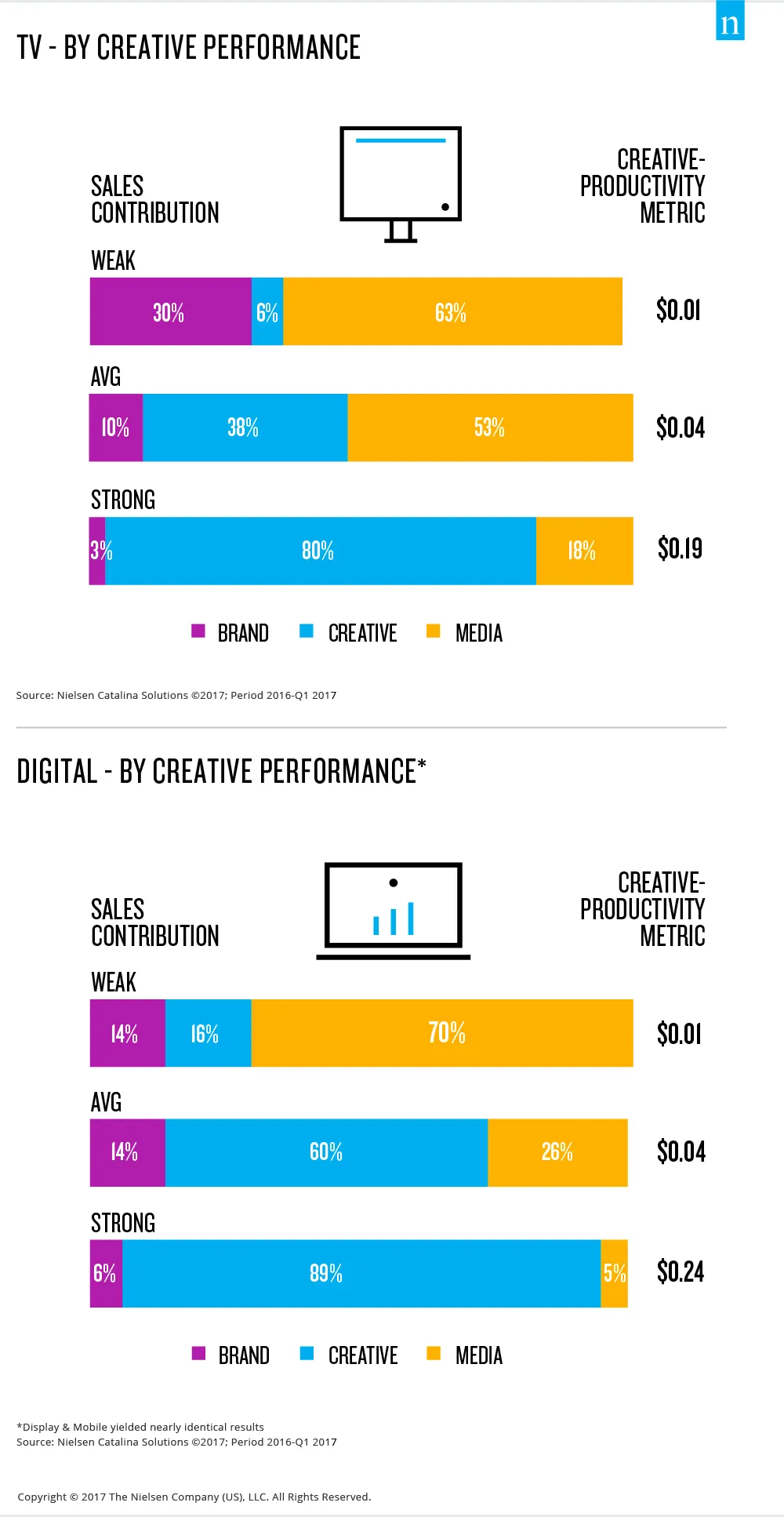
One of the most widely cited analyses came from Nielsen Catalina Solutions, which examined thousands of advertising campaigns across television and digital environments. The research found that campaigns with strong creative dramatically increased the contribution of creative to sales outcomes.
The research found that creative quality was the single largest driver of advertising effectiveness, accounting for 47% of sales impact across nearly 500 campaigns analysed. Other factors such as reach, brand strength and targeting contributed smaller shares.
2023: NCSolutions update to the Five Keys of Advertising Effectiveness
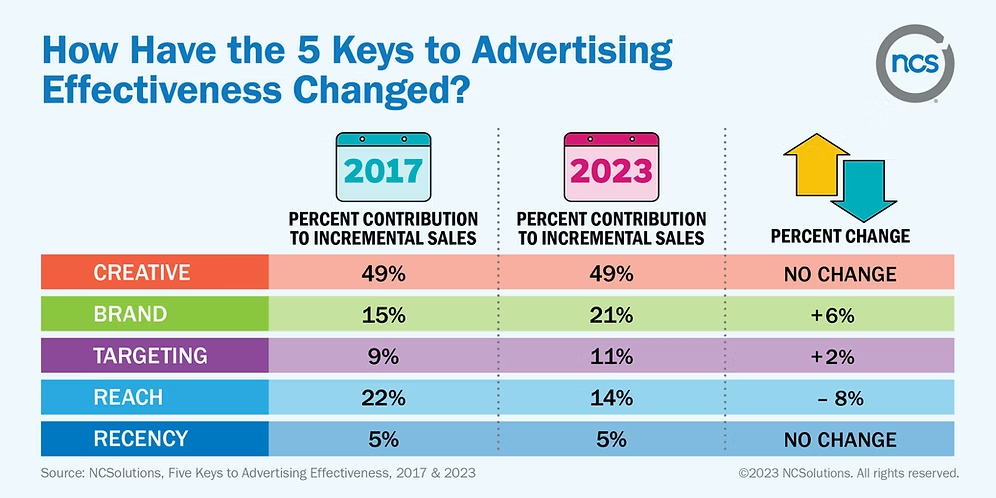
More than fifteen years after the original Project Apollo research, updated analysis from NCSolutions revisited the drivers of advertising effectiveness using a meta-analysis of nearly 450 campaigns across digital and television channels.
“Advertising creative drives nearly half (49%) of incremental sales and remains the most critical driver of advertising effectiveness.”
The updated study found that creative execution continued to account for the largest share of campaign impact, generating roughly 49% of incremental sales. Brand factors accounted for 21%, targeting for 11%, reach for 14% and recency for 5%.
What the timeline shows
Across nearly two decades of research, the proportion attributed to creative quality has remained remarkably consistent. Early cross-media analysis from Project Apollo suggested that creative could drive around 65% of advertising effectiveness. Later analysis from Nielsen Catalina Solutions found the creative responsible for 47% of total sales impact, the largest single contributor among campaign variables.

Across nearly two decades of research, creative quality consistently accounts for roughly half of advertising effectiveness.
More recent modelling from NCSolutions continues to show similar proportions, with creative accounting for roughly 49% of incremental sales. Despite the rise of automation, programmatic media buying and advanced targeting capabilities, the quality of the creative message remains the most consistent driver of campaign performance.
This reinforces a key point raised in the episode with Matt Daley: when brands say their ads “don’t work,” the underlying issue often sits further upstream than media optimisation. In many cases, the real constraint is the strength of the message, the clarity of the offer, or how effectively the creative communicates the product’s value.
Why joined-up growth beats channel silos
A recurring thread in the episode is that paid media and SEO should not be treated as rival departments competing for credit. That is a bad internal model and an even worse client model.
From the client’s perspective, the commercial goal is what matters. They do not care whether growth came from paid search, organic search, paid social, or a better product page. They care whether the business moved.
This is one of the reasons the episode sits comfortably inside the Beyond SEO brand. Modern growth is not about obsessing over one channel in a vacuum. It is about understanding how channels support each other across demand capture, demand creation, validation and conversion.
Google’s messy middle work makes a similar point from a different angle. It explicitly notes that the behaviours shaping decisions often fall between traditional branding and direct-response buckets, and that this creates organisational divides that matter more to marketing teams than to consumers.
If that sounds familiar, it should. It is the same structural problem many brands still have internally. Search, paid social, content, CRO and product are often measured separately, briefed separately, and reported separately, even when the customer experiences them as one journey.
Better reporting is not more reporting
Another useful idea in the episode is that stakeholders do not need endless dashboards thrown at them. They need clarity. They need context. They need a story that connects activity to commercial movement.
Matt talks about using data to tell a story, not just to fill pages. That sounds obvious, but many agencies still miss it. Reporting often becomes a ritual of metric delivery rather than a process of commercial interpretation.
Nielsen’s 2023 Annual Marketing Report reinforces part of this. In its study of 15 brands and 82 digital campaigns, the company found that ads reaching the intended audience generated significantly higher ROI than those that did not. That is useful not because it gives marketers another metric to screenshot, but because it reminds us what reporting should actually do: surface the levers that change outcomes.
That is the difference between descriptive reporting and strategic reporting. One tells you what happened. The other helps you decide what to do next.
Agency growth is not always the win it looks like
There is also a more uncomfortable founder lesson running through the episode. Growth can be real and still be wrong.
A bigger agency, more headcount, and higher top-line revenue can create a business that is less profitable, more stressful, and more detached from the founder’s strengths. That is not theory. It is one of the lived realities Matt describes when reflecting on scaling, team growth, margin pressure, client stress and losing touch with hands-on delivery.
“Being unaligned kills a business.”
That idea extends beyond clients. It applies to co-founders, teams, service models, and the hidden assumptions people import from hustle culture. If one founder wants a lifestyle business and the other wants a high-growth machine, the conflict is not operational. It is structural.
The IPA’s summary of Les Binet and Peter Field’s work, The Long and the Short of It, is relevant here too. One of its core principles is to integrate brand and activation, while measuring both short- and long-term effects. That same logic can be applied to agency building. Chasing only short-term revenue at the expense of service quality, margin, health or positioning usually catches up with you.
Time, health and the founder trade-off nobody markets well
One of the more honest aspects of this episode is that it does not glamorise stress. Matt talks openly about the personal side of founder pressure, including panic attacks, burnout signals, and the need to design a business around an actual life rather than a story about success.
“You can’t put a price on time.”
That is easy to dismiss as lifestyle content until you look at the operational consequence. Founders who are chronically stressed usually make worse decisions. Teams under pressure cut corners. Clients feel the instability. Margin gets thinner. Delivery slips. Retention suffers. So even if you only care about business performance, founder wellbeing is not a soft issue. It is a commercial one.
Matt’s version of the answer is not to abandon ambition, but to redefine it. RUNWAY FIVE is positioned less as a race to headcount and more as a selective, commercially-minded model built around strong client fit, strategic paid media delivery and a better quality of life.
What founders and marketing teams should take from this episode
If there is one takeaway from this conversation, it is this: underperformance is rarely solved by pulling one tactical lever harder.
When ads are not working, brands should ask tougher questions first:
- Is the product genuinely strong enough?
- Is the positioning clear and differentiated?
- Does the creative match the buyer’s stage of awareness?
- Are paid, organic and product signals pulling in the same direction?
- Are reports surfacing commercial truth, or just channel activity?
- Is the business model aligned with the lifestyle and outcomes the founder actually wants?
That is the real “fix first” logic. Not endless platform tinkering. Not performance theatre. Not defaulting to more spend because it feels decisive.
Final thought
What makes this episode land is that it connects marketing effectiveness with founder clarity. The two are not separate.
Better ads come from better alignment. Better agencies come from better fit. Better growth comes from understanding that channels do not grow businesses on their own. Strategy, positioning, product truth and commercial discipline still sit underneath all of it.
If you are a founder, agency leader, or in-house marketer trying to work out why performance has stalled, this episode is worth your time.
Connect with Matt Daley
LinkedIn: Matt Daley
Website: RUNWAY FIVE
