


Technical SEO is still too often treated as a specialist function, while PPC sits in its own lane and content runs on a separate plan. Product, UX, and sales teams operate to different KPIs. On paper, each team is doing its job. In reality, the business often ends up fragmented.
That was the core theme of my recent “Beyond SEO” webinar with Lumar:
My view is simple. SEO should not be treated as a siloed traffic channel. It should be understood as a structural layer across the wider marketing and commercial ecosystem. When search, content, paid media, product, UX, and sales align around the same customer and the same commercial goals, performance compounds. When they do not, brands stay stuck in channel-level optimisation while missing far bigger growth opportunities.
SEO should not sit in a silo. It should help shape how the business connects demand, experience, and revenue.
Why SEO, PPC and content underperform when they operate in silos
One of the most important points I made in the webinar is that most organisations still structure search and marketing around internal functions rather than around the customer journey. SEO has its targets. PPC has its own landing pages. Content has a separate roadmap. Product and sales teams have different priorities again.
This was a common discussion point on our Beyond SEO podcast episode with Edd Wilson from Frontify.
The problem is that customers do not experience your brand in silos. They do not care whether they arrived through an organic result, a PPC landing page, a blog article, or a branded search. They care whether they found the right answer, on the right page, with the right experience.
That is why disconnected execution causes so much waste. PPC often ends up compensating for weak organic coverage. Content teams produce material that does not connect clearly to commercial journeys. SEO teams focus on rankings without enough influence over product, UX, or page intent. The result is not just inefficiency. It is missed revenue.
The customer does not see channels. They see one brand experience.
For me, that is where technical SEO becomes more commercially important than many businesses realise. It is not just about crawlability, indexing, or resolving issues in isolation. It is about helping shape the structure through which the whole business is understood by users, search engines, and increasingly AI-driven search experiences.
My Beyond SEO framework: why strategy should not start at strategy
In the webinar, I introduced a framework I call DCBAS. The reason I built it is because too many brands start with the visible layer of search strategy before they have built the foundations that make that strategy viable.
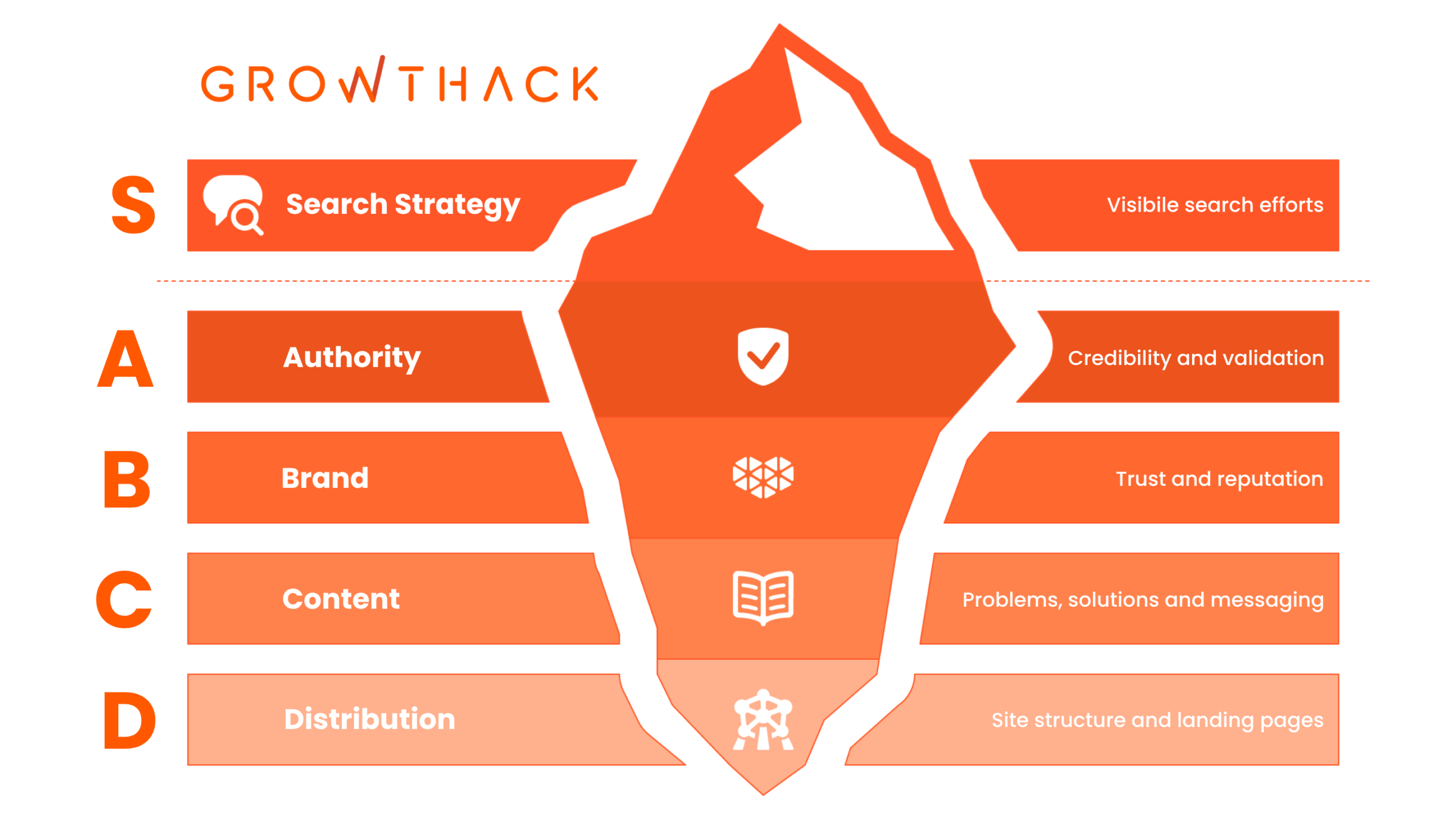
The framework works from the bottom up:
- D = Distribution. How your brand shows up and how your website is structured. This includes site architecture, channel presence, and the ways users find and describe what you do.
- C = Content. The quality, structure, usefulness, and relevance of your pages. Are you answering real use cases and real customer problems?
- B = Brand. Whether people know you and trust you.
- A = Authority. The validation layer. Links, citations, mentions, media coverage, and signals of trust.
- S = Search Strategy. The strategic layer that sits on top, including SEO, PPC, and increasingly AI search planning.
The point I wanted to make is that winners do not start at the top.
Winners build from distribution upward.
If your structure is weak, your pages are misaligned, your brand is underdeveloped, and your authority is thin, then your search strategy will always be constrained, no matter how strong the tactical execution appears on the surface.
Search strategy is often not the first thing that is broken. The foundations underneath it are.
This matters because it changes the question. Instead of asking, “What is our SEO strategy?” businesses should be asking, “Have we built the conditions that make search performance possible?”
1. Use search data to reveal demand, not just report on traffic
The first practical workflow I covered in the webinar was about opportunity. Search data should not just be used for reporting. It should be used to reveal where demand is being captured, where it is being missed, and where the structure of the website is not doing enough heavy lifting.
Whenever I work on a new brand, one of the first things I want to understand is where traffic is concentrated. A weak SEO setup often becomes obvious quite quickly. The homepage attracts too much of the visibility, while only a few other pages contribute meaningfully. That usually tells me the site is underbuilt from a category, landing page, or intent perspective.
In a healthier setup, I do not want the homepage doing all the work. I want to see strong landing pages, category pages, service pages, and commercially relevant content attracting customers across the journey.
If your homepage is carrying the whole strategy, you probably do not have enough depth in the rest of the site.
PassMeFast: when PPC performance exposed an organic gap
In the webinar, I shared an example from PassMeFast, a brand that delivers intensive driving lessons across the UK. We noticed that they had a prices page that looked disconnected from the wider site structure.
They offered courses, but there was no clear courses folder supporting that area of the site, so the page lacked topical relevance and did not sit in a strong organic context.
What made it more interesting was that the team told us this page was actually one of their highest-performing PPC landing pages. That immediately raised the right question. If this page is commercially important in paid media, why is the organic setup around it so weak?
When I checked the search data, the opportunity became clearer. The page had high impressions, low clicks, and a very weak click-through rate. So we tested a new approach. We reworked the page so it became more about the courses as a whole, while still including pricing information. That shift improved the page and generated more clicks in the test period.

The wider lesson was not just about one page. It was about cross-channel alignment. If PPC is relying on a page that organic search has not properly supported, the issue is not that paid media is doing too much. The issue is that the site architecture and content logic are not helping the business capture full value across channels.
If PPC is doing all the work, that may not mean paid media is winning. It may mean your organic structure is underbuilt.
2. Site architecture is not a technical detail. It is a growth lever
A big part of the webinar focused on site architecture because I think it remains one of the most underrated growth levers available to technical SEO teams. Businesses often treat it as a technical concern, but in practice it shapes discoverability, user journeys, PPC targeting, internal linking logic, and how clearly a brand can map itself to real market demand.
Too many websites are still shallow. They have one broad category page, a few subpages, and then a scattered collection of content that never quite connects to the way customers actually search or buy.
That creates two problems. First, search engines receive weak thematic signals. Second, users do not land on pages that reflect their specific needs, use cases, or buying context. Both reduce performance.
Site architecture is not just about crawl paths. It shapes how demand is captured and how users move toward conversion.
Expanding category depth to unlock better performance
I shared an e-commerce example involving a mobility brand selling rollators. The business had just one main page for the category. That limited their ability to rank for different product types and meant users were not landing on pages tailored to specific intents.
The opportunity was to deepen the structure. Instead of relying on one broad page, the site could support multiple subcategory pages around different rollator types, such as lightweight, all-terrain, indoor, and heavy-duty options. That gave search engines stronger signals, gave customers more relevant landing experiences, and gave PPC campaigns more precise targets.
That work was tested before a migration and rebrand, then carried forward to the new site. The outcome was not just improved visibility. It also contributed to a better conversion rate and a stronger average order value after launch.
That is why I keep pushing this point. Site architecture is not a hygiene task. It is often a direct commercial lever.
3. Product and sales insights should shape content strategy more than keyword volume alone
Another major point I made in the webinar is that a strong content strategy should not be driven purely by keyword opportunity. Search data matters, but it does not tell you everything that matters commercially.
If you want better content planning, you need stronger feedback loops between SEO, content, sales, and product teams.
Those conversations reveal what customers keep asking, which products matter most, where sales teams see friction, and which pages are not reflecting how the business actually wins revenue.
Keyword data shows demand. Internal feedback shows what the business actually needs to say about that demand.
The wine rack example: your best-selling use case needs a page
One simple example I shared involved a wine rack brand. Through discussions with the business, I found out that one of their most popular installation types was under-stairs wine racks. Yet there was no dedicated page on the website for that use case.
That kind of gap matters. It means the business already knows something commercially important, but the website is not reflecting it clearly enough. In those situations, the market is giving you the answer. The structure and content simply have not caught up.
This is exactly why content strategy should not be isolated from product and commercial reality. The best opportunities are not always hiding in a keyword tool. Sometimes they are already sitting inside your sales calls, customer questions, and product conversations.
B2B content should help qualify, not just attract
I also discussed a B2B SaaS example where lead quality, rather than traffic volume, was the real issue. The business had a sales acceptance rate below 15 percent for marketing-qualified leads. Leads were coming in, but too many were not the right fit. Example from elementsuite case study below.
Once we looked more closely and included the right internal feedback, the reasons became clearer. Some prospects were too small. Some were outside the ideal customer profile. Some were landing through content that generated attention, but not enough qualification.
That changes how content should be approached. The job is not just to maximise visibility. It is to communicate who the product is for, who it is not for, and what context makes it valuable. That improves relevance earlier in the journey and increases the chance that sales receives leads it actually wants.
Good SEO content should not just increase lead volume. It should improve the quality of the leads the business is willing to accept.
4. Migrations should be treated as growth opportunities, not just risk management
Migrations are often framed too narrowly. The conversation usually centres on preserving rankings, protecting traffic, and avoiding loss. Those things matter, of course, but they are not the whole story.
In the webinar, I argued that migrations should also be seen as opportunities to rebuild a site around the way customers actually search, navigate, and buy. Done properly, a migration becomes a rare moment where structure, UX, content, SEO, PPC, and commercial intent can all be improved at once.
That is why technical SEO teams should be involved much earlier. Not just at the end to review redirects or flag technical issues, but in the strategic planning around categories, templates, page logic, and how the future site should support broader growth.
A migration is not just a preservation exercise. It is often the best chance a brand has to rebuild for how people actually search and buy.
Thinking in customer lenses, not just internal page types
One idea I introduced here was the concept of customer lenses. Customers do not always evaluate products or services in one fixed way. Depending on the sector, they may search by problem, sport, industry, location, use case, audience type, product feature, or environment.
That means websites should not simply mirror internal business language or organisational charts. They should reflect the ways customers naturally classify what they are looking for.
I shared an example involving a sports pitch construction brand. Their previous website structure was scattered and did not give enough clarity around sports, surfaces, services, and systems. By restructuring the site around clearer customer lenses, the business created more intuitive journeys for users and stronger relevance signals for search.
The impact was significant. The work contributed to major global growth, stronger click performance over time, more qualified CRM leads, and improved conversion outcomes.
What should technical SEO teams do differently now?
If there is one broader argument behind this webinar, it is that technical SEO teams are often much closer to commercial insight than they are given credit for. They can see how search demand maps to site structure. They can see where landing pages are weak. They can spot when content does not match intent. They can identify when PPC is compensating for structural SEO gaps.
That means their role should be bigger than issue resolution. Technical SEO should help connect demand, structure, user intent, content, and commercial outcomes.
- Stop treating rankings and clicks as the end goal. They are signals, not the final business outcome.
- Use search data to uncover demand gaps, weak page intent, and missing category coverage.
- Bring PPC, content, product, UX, and sales into the conversation earlier.
- Build site structures around how customers search and evaluate, not just around internal naming conventions.
- Treat migrations and restructures as strategic growth moments, not just technical risk exercises.
The best technical SEO work does not stop at fixing problems. It helps shape how the whole business captures demand.
Final takeaway
The central idea behind Beyond SEO is not that SEO matters less. It is that SEO matters more when it is connected to the wider system around it.
Search performance rarely breaks only at the strategy layer. It usually breaks further down, in structure, in weak landing page logic, in poor alignment, in underdeveloped content, or in disconnected execution across teams.
That is why I believe the strongest SEO teams now need to think beyond rankings and beyond channel reporting. They need to think in terms of systems, journeys, user intent, and commercial outcomes.
When SEO, PPC, content, product, and sales align around the customer, the website stops behaving like a collection of disconnected pages and starts working like a genuine growth engine.
Beyond SEO is not about moving past SEO. It is about finally using it in the wider way the business actually needs.
Watch the webinar
If you want the full walkthrough, including the DCBAS framework, the PassMeFast example, and the practical ways I think technical SEO, PPC, and content teams should align, you can watch the full webinar with Lumar.
If your business is rethinking how SEO fits into the wider growth system, or you want support aligning technical SEO, content, PPC, and site structure around commercial outcomes, get in touch with Growthack.
