


Over the past few months, we’ve seen a clear pattern emerge across client accounts (not just ranking volatility) in changes to indexation, content thresholds, and how Google evaluates page-level value.
- Read: “A new era for AI Search” by Elizabeth Reid, VP, Head of Search at Google
The March and May 2026 core updates, combined with announcements from Google I/O, give us a clearer view of where search is heading. We’ve seen massive advancements in AI scale, infrastructure, and agentic capabilities.
Here is a summary of the key statistics and major announcements shared so far…
Key AI Adoption Statistics
- Token Usage: Google is processing 3.2 quadrillion tokens per month, a sevenfold increase from previous metrics (0:39).
- Product Scale: There are 13 products with over 1 billion users, with five of those surpassing 3 billion users (0:46).
- Gemini App Growth: The Gemini app has reached 900 million monthly active users, more than doubling in a year (1:13).
- AI Overviews & Search: AI Overviews now serves over 2.5 billion monthly users, and AI mode in Search has surpassed 1 billion users in its first year (0:58-1:11).
- Synth ID: This watermarking tool has been applied to over 100 billion images and videos (3:40).
Major Technical Announcements
- Gemini Omni: A new multimodal model designed to create any output from any input, starting with video (3:11).
- Gemini 3.5 Flash: A high-speed, frontier-capable model optimised for efficiency, already available across products and APIs (4:02, 6:01).
- Gemini Spark: A personal AI agent that runs on dedicated virtual machines in the cloud, designed to handle long-running tasks in the background even when your device is off (6:36).
- Infrastructure: The introduction of Jackson Pathways, which allows Google to scale training across over 1 million TPUs globally (2:16).
- Google Pix: A new workspace tool for advanced image creation and editing (11:42).
- Audio Glasses: Coming this fall, these glasses (built with partners like Samsung) aim to provide all-day Gemini assistance spoken privately to the user (12:32).
I’m personally not too keen on having wearable technology ALL the time. I wear glasses. Will I want audio glasses now? – I don’t know. I’m not completely sold on the idea. So I’m interested to see how people take to this as “voice search” has been promised as the next big thing for over a decade. This year could be the turning point, however, as voice related technology is now being pushed more aggressively.
1. March 2026 Core Update Reveals Indexation Is No Longer Assumed
The most noticeable shift began with the March 2026 core update.
Google confirmed the rollout started on March 27 and was completed on April 8. During that period, we observed consistent volatility across multiple client sites.
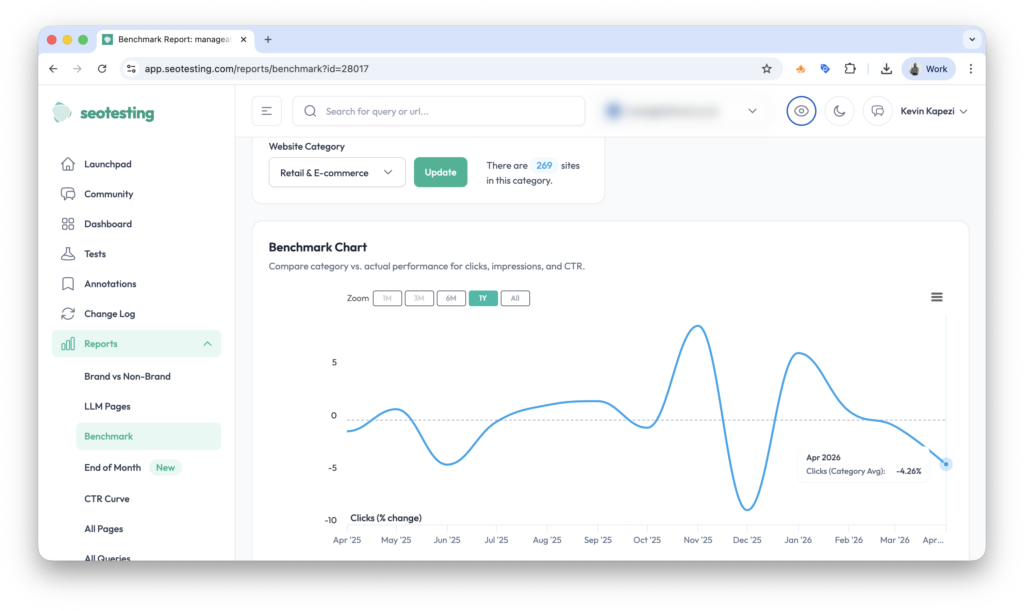
This wasn’t isolated. Industry-wide tracking showed similar movement:
The key change is not rankings but indexation.

- High-quality, intent-aligned content is being indexed faster
- Thin or templated pages are being ignored more frequently
- Technical validity alone is no longer enough to secure visibility
This is particularly visible in eCommerce.
Category and brand pages that rely on templates without meaningful differentiation are struggling. Historically, these pages scaled well. That model is now materially less reliable.
Indexation is no longer a default state. It is a filtered outcome.
2. May 2026 Core Update Brings Continuous Refinement, Not One-Off Events
Shortly after the March rollout completed, Google began rolling out another core update in May 2026.
At the time of writing, this update is still in progress. Early signals suggest continued volatility, particularly across sites with large volumes of overlapping or low-value pages.
Coverage of the rollout:
Two updates in quick succession is not accidental.
It suggests a more iterative model, where Google continuously adjusts quality thresholds rather than relying on isolated updates.
The implication is clear.
Sites that rely on scale without depth will continue to lose ground.
3. The Real Shift Becomes Content Efficiency and Structural Clarity
One of the most consistent issues we’re seeing is inefficiency.
Not just low-quality content, but duplicated intent across multiple pages.
- Multiple pages targeting the same topic
- Overlapping category structures
- Legacy content that no longer serves a purpose
Historically, this created mild dilution.
Now, it creates friction in crawling, indexing, and ranking.
Google is making more explicit decisions about what to include. If your structure is unclear, those decisions will not go in your favour.
The practical shift is towards consolidation.
- Fewer pages
- Stronger intent alignment
- Clearer hierarchy
Efficiency is becoming a ranking factor in everything but name.
4. Programmatic SEO Could Still Be Viable, But No Longer Forgiving
Programmatic SEO is not disappearing. It is being forced to mature.
Templated page creation still works when it is:
- Supported by unique data
- Contextually differentiated
- Genuinely useful to a specific audience
What no longer works is scale for its own sake.
If every page looks interchangeable, Google will treat them that way.
This applies across:
- eCommerce category pages
- Location landing pages
- Author and profile templates
The baseline expectation has shifted from presence to usefulness.
5. Google I/O: Search Is a Discovery Layer
Google I/O did not introduce a new direction. It confirmed an existing one.
Search is evolving from a retrieval system into a discovery layer.
Users are increasingly guided towards answers, products, and decisions within the interface itself.
Key coverage:
- Search Engine Roundtable: Google I/O AI Search Updates
- TechCrunch: Google updates its Gemini app to take on ChatGPT and Claude at IO 2026
- The Verge: The 13 biggest announcements at Google I/O 2026
This has two immediate implications:
- Fewer clicks for informational queries
- Greater emphasis on being selected, not just ranked
Visibility is shifting from position to inclusion.
6. Agentic Commerce Is The Latest Layer of Search
One of the more important developments from Google’s AI direction is the move towards agentic behaviour.
Not just answering queries, but assisting with decisions and transactions.
This is what we refer to as agentic commerce.
Instead of:
- User searches
- User clicks
- User converts
- User compares
The new user flow fundamentally changes the role of search
The flow now becomes:
- User expresses intent
- AI surfaces options
- AI assists in evaluation
- AI facilitates the transaction
Your website is no longer just competing for clicks. It is competing for selection by systems.
That selection is based on:
- Structured data
- Content clarity
- Entity-level understanding
- Trust and authority signals
This is where traditional SEO and AI visibility begin to converge.
7. The Misstep: Overcorrecting Towards AI Platforms
A common reaction to these changes is to shift focus away from Google and towards platforms like ChatGPT.
This is premature.
Google still dominates discovery at scale. Not just in traditional search, but increasingly within AI-enhanced experiences.
The more rational approach is:
- Prioritise Google as the primary discovery channel
- Structure content to be understood by AI systems
- Expand into emerging platforms without overcommitting
Follow demand. Not noise.
8. What This Means in Practice
The direction is clear. Execution is where most teams fall short.
Based on what we’re seeing across clients:
- Content quality must improve at every page level
- Template reliance must decrease
- Duplicate and overlapping pages should be consolidated
- Site structure must reflect real user intent
- Authority signals must extend beyond the website
None of this is new.
The difference is that it is now enforced.
Final Thought
Search is becoming more selective, more integrated, and more outcome-driven.
The fundamentals have not changed. The tolerance has.
The winners will not be those chasing AI trends.
They will be those building systems that align with how discovery, evaluation, and decision-making actually work.
That is where search is heading.
